

Atatürk and Turkish Agriculture
Author: Bilge Keykubat
The year is 2021…
Fertile land is extremely valuable.
Water is a vital resource.
Climate change is affecting the future of the world.
Temperatures have reached critical levels.
Food production and the equitable distribution of food are highly disproportionate.
Hunger continues to increase with each passing day.
Water and food have now become instruments of war.
Will “Mother Earth” be able to survive?
And now, with the pandemic,
another question has been added:
Will we go hungry?…
In ancient times, people instinctively searched for and gathered plant- and animal-based foods from nature in order to survive, much like animals did. Since they were constantly searching for food, they lived as nomads. Using very primitive preservation methods, they stored what little food they could find in nature. The exchange and trade of food had not yet begun.
Mother Nature had not yet revealed all her blessings to humankind. There were no extravagant clothes, luxurious houses or, of course, waste.
However, encounters between different groups began to increase over the years. It was during those times that people began seizing one another's possessions.
Food was extremely important even in the earliest periods of history…
Agriculture essentially began when people observed that the seeds, tubers and bulbs they had gathered and stored, however primitively, began to germinate and produce new plants.
Human communities passed their discoveries from one group to another, developing new methods. As the years passed and new knowledge was added to what had already been learned, these methods became increasingly advanced.
Years passed, new states were established, new peoples emerged, and food naturally became increasingly important. As a result, agriculture had to continue developing.
Anatolia, meanwhile, has always demonstrated its fertility and abundance to all the people who have lived upon it. These ancient lands, capable of producing all the sacred fruits mentioned in different religions, have made these fruits, like Anatolia itself, symbols of continuous giving and production.
The fertile lands of Anatolia have always attracted people.
Since ancient times, economic life in Anatolia had been based on agriculture. With its fertile plains, excellent climate and relatively sufficient water resources, Anatolia clearly stood out as one of the most suitable regions for agriculture. Combined with its geographical strength, these characteristics made it a natural homeland from the earliest periods of history. The domestication of animals and efforts to protect cultivated fields from other groups and wild animals facilitated the transition to settled life.
Agriculture During the Ottoman Empire…
Agriculture was the most important sector of the economy in the Ottoman Empire, which came close to realizing its ambition of turning the Mediterranean into an inland sea and held a prominent place in world history for more than 600 years. The population, which initially led a nomadic way of life, gradually transitioned to settled life as the Empire developed and its administrative system became established.
Until the beginning of the 17th century, the Ottoman state was self-sufficient in agricultural products. However, periodic droughts, floods, rebellions, migrations and the deterioration of the timar system resulted in production losses. While grain production, vineyards and horticulture were particularly prominent, the development of industry in Europe from the 18th century onward increased the importance of industrial crops such as tobacco and cotton. Furthermore, as Europe's demand for agricultural products increased, production in the Ottoman Empire evolved from subsistence-level agriculture toward a level capable of meeting the needs of the market economy. In livestock farming, animals such as oxen and buffalo were used for cultivating the land; their meat, fat and milk were used as food; their wool and hides were used in industry; they were employed in transportation; and taxes collected from livestock constituted a source of state revenue.
Ottoman records indicate that 80–90% of the population earned income from agricultural activities.
During the early Ottoman period, farmers were identified and categorized according to the type and scale of production they carried out. Peasants were classified and taxed according to the size of the land under their use, under categories such as çift, nîm çift, bennâk, caba and mücerret. Agricultural activities were conducted under state supervision.
This land system based on state ownership was known as “mir-i arazi.” Under the mir-i arazi regime, the ultimate ownership of the land belonged to the state. The system was established directly by the administration and introduced a hierarchical structure of landholding. The Sultan, who held the largest share of the land, was followed by the Grand Vizier, viziers, commanders, governors-general, district governors and sipahis who were granted dirlik lands in return for military duties.
The peasant cultivated the land as a tenant. In return for the right to use the land, the peasant was obliged to pay taxes to the state.
The Ottoman mir-i regime incorporated three different land systems.
Has; These were dirlik holdings generating an annual income of more than 100,000 akçe and were allocated to senior administrators. Unlike timar holders, holders of has lands were required to provide one soldier for every five thousand akçe of income. Since has holdings were granted according to official position, their holders changed frequently.
Zeamet; These were dirlik holdings generating an income of between 20,000 and 100,000 akçe and were granted to second-ranking commanders, beys and district governors. Holders of zeamet, known as zaim, were also required to provide one soldier for every five thousand akçe of income. As with timar holders, these lands could be transferred from father to son only to a very limited extent, with permission, and generally in reduced size.
Timar; The timar system, which aimed to ensure the uninterrupted production of grain by cultivating land in an economically rational manner, formed the foundation of Ottoman agriculture. The system was based on the Seljuk land arrangement known as the “military iqta” system. The iqta system originated during the time of Caliph Umar, when lands left without owners following conquests were allocated to individuals on the condition that taxes were paid to the state.
As is well known, the timar system was based on assigning certain state revenues, in return for service, to individuals known as dirlik holders, who generally undertook military and administrative duties. Through the timar system, the state avoided the obligation of establishing and maintaining a large financial organization to collect tax revenues, while simultaneously maintaining order in the provinces and creating a substantial military force for wars.
Under the timar system, land could, to a limited extent and usually in reduced form, pass from father to son. Since this differed from the feudal system experienced in Western societies, which created rigid class distinctions, it enabled the system to function for a long period.
The rights granted to farmers who rented and cultivated the land were also among the most important aspects of the Ottoman land system.
At the same time, farmers who failed to cultivate their land for three consecutive years, except when leaving it fallow, were required to pay a tax known as “çift bozan” or “leventlik akçesi” to compensate for losses resulting from leaving the land uncultivated.
In return for the use of land, and taking its fertility into account, an in-kind “aşar/öşür” tax ranging from 1/10 to 1/50 of the harvested crop was collected. Farmers also paid the state an annual land-rental tax known as “çiftçi akçesi,” which ranged between 33 and 36 akçe. In addition, taxes known as “baş” were levied on goods sold in markets, while landless farmers or those possessing very little land were subject to taxes under the category of bennak.
Historical records show that cereals were among the most important agricultural products. During this period, despite restrictions, substantial revenues were generated particularly from wheat exports to Egypt, Venice and Thrace. Rice, cotton, hemp, cannabis and tobacco became important commercial crops. Vegetable cultivation, livestock farming—particularly sheep breeding—and fruit growing, especially viticulture, were also among the leading agricultural activities. One of the principal factors behind the development of vineyards and orchards was that these areas had to be enclosed for cultivation, which contributed to the transformation of mir-i land into privately owned property.
The abundance of pastureland, high levels of meat consumption, the widespread practice of leatherworking, the continuation of traditional lifestyles and the presence of subsistence farmers were among the main factors contributing to the expansion of sheep farming.
The land regime played an important role in the development of the Ottoman Empire. Through the mir-i arazi system, the Empire was able to maintain a large military force and rule across three continents for many years. However, with the onset of the period of stagnation, the land system—and therefore the mir-i arazi order—began to deteriorate. The deterioration of the regime resulted from a number of interconnected factors.
Opening Address at the İzmir Economic Congress, February 17, 1923
…
Throughout Ottoman history, all efforts and all endeavors were undertaken not in accordance with the wishes, aspirations, and real needs of the nation, but rather to satisfy the personal ambitions and passions of certain individuals. For example, after Mehmed the Conqueror captured Istanbul—that is, after inheriting the legacy of the Seljuk Sultanate and the Eastern Roman Empire—he sought to establish a great empire by conquering the Western Roman Empire as well. He pursued such an expansive ambition. In order to pursue and realize this ambition, he directed the entire nation, the principal element, toward this objective. Likewise, Sultan Selim I, while consolidating the western front opened by Mehmed the Conqueror, pursued a political course aimed at uniting all of Asia and establishing a great Islamic Empire. He led the principal element of the nation along this path. Suleiman the Magnificent pursued an immense and magnificent policy of expanding both fronts to their furthest extent, turning the entire Mediterranean into an Ottoman basin, and establishing his power over India. He used the principal element of the nation to implement this policy.
Friends, if the true nature of all these undertakings and actions is examined, it becomes clear that these great and powerful sultans based their foreign policies on their own ambitions, passions, and desires. While pursuing their grand and magnificent aspirations, they were compelled to organize their domestic institutions and internal policies according to the foreign policies born of those ambitions. However, foreign policy must be based on domestic organization and internal policy. In other words, it must not extend beyond the capacity of the domestic structure to sustain it. Otherwise, those who pursue imaginary foreign policies inevitably lose the very foundation on which they depend.
Indeed, the Ottoman rulers forgot this fundamental principle. They based all their actions and policies on their emotions and ambitions. When they were compelled to adapt their domestic organization to their foreign policy, they attempted to preserve, exactly as they were, all the different elements in the territories they conquered—peoples with different languages, religions, traditions, and cultures—and granted them privileges that enabled them to preserve all these characteristics. Meanwhile, the principal element of the nation exhausted itself through long military campaigns, dying on battlefields, sustaining the conquered territories and their populations, and guarding them.
At the same time, the nation—the principal element—was almost entirely deprived of the opportunity to work in its own home and homeland to meet its own vital needs. These crowned rulers were not content merely with leading the nation from one land to another and preventing it from thinking about its own homeland. In order to satisfy the populations acquired through conquest, and later to satisfy foreigners, they directly gave away many of the rights, vital resources, and economic resources of the principal element as gratuitous assistance and gifts.
For example, the privileges granted to the Genoese and the Patriarch during the reign of Mehmed the Conqueror opened a path that was continuously broadened and reinforced after him. These privileges were granted when the state was at its strongest and greatest. They were granted merely as assistance bestowed freely by a sultan. You may all recall that during the reign of Suleiman the Magnificent, a commercial agreement was made with the Venetians. Yet the Sultan considered entering into a commercial treaty with Venice beneath his dignity and honor. In his understanding, treaties were concluded between nations of equal standing. Venice at that time, far from being equal to the Ottoman State, was directly under its protection. Therefore, the Sultan could not conclude a treaty with such a state; he could only grant it favors. And that is what he did.
The word describing these favors was translated as “capitulations.” Yet, as you know, the word capitulation is used for those who, after being surrounded inside a fortress and exhausting their means of defense and protection, are compelled to surrender. Such a word came to be used in translating the favors granted by the sultans. Let me repeat this small detail from two perspectives: the nation was prevented from attending to its own vital needs and was led from one land to another, while the populations of these new territories continued to work while enjoying numerous privileges.
In other words, while the conquerors led the principal element behind them and made conquests with the sword, the peoples of the conquered lands, benefiting from the privileges they had obtained, took hold of the plough and worked the soil. Friends, those who conquer with the sword are destined to be defeated by those who conquer with the plough and ultimately to surrender their place to them. This is precisely what happened to the Ottoman Empire. Bulgarians, Serbs, Hungarians, and Romanians held on to their ploughs, preserved their existence, and grew stronger; meanwhile, because our nation followed such conquerors from place to place and failed to work in its own homeland, it was eventually defeated by them. This is a truth that has manifested itself in every period of history and in every part of the world. For example, while the French wielded the sword in Canada, English farmers entered the land. In this struggle between the civilized plough and the sword, it was ultimately the plough that prevailed and took possession of Canada. Gentlemen, the arm that wields the sword becomes tired; eventually it returns the sword to its sheath, where perhaps it is condemned to corrode and rust. But the arm that uses the plough grows stronger day by day, and as it grows stronger, it gains possession of more land. (http://www.atam.gov.tr)
If we briefly consider the decisions concerning agriculture adopted at the İzmir Economic Congress held between February 17 and March 4, 1923:
- Industrial sectors whose raw materials are produced or can be produced domestically should be established.
- A rapid transition should be made from handicrafts and small-scale manufacturing to factories and large-scale enterprises.
- The state should gradually become an institution with an economic perspective as well, and enterprises that cannot be established by the private sector should be undertaken by the state.
- A State Bank should be established to provide credit to private enterprises.
- In order to withstand foreign competition, industry should be established in a coordinated and integrated manner.
- Monopolies established by foreigners should be avoided.
- Industry should be encouraged and national banks should be established.
- Railway construction should be carried out within the framework of a planned program.
- Those engaged in labour should be called workers rather than labourers.
- The right to form trade unions should be recognized.
According to Prof. Dr. Zeki Hafızoğulları (http://www.atam.gov.tr/dergi/sayi-46/izmir-iktisat-kongresi-gorusler-ve-degerlendirmeler), among the most important outcomes of the İzmir Economic Congress were the following:
On the one hand, the İzmir Economic Congress determined the fundamental principles and directions, according to prevailing conditions and possibilities, concerning agriculture, forestry, public order, transportation, finance and taxation, banking, insurance and stock exchanges, trade, industry and customs, mining, the establishment of chambers of agriculture, commerce and industry, workers, labour and trade unions, as well as education and training in economics, agriculture, commerce and industry. On the other hand, it sought to determine the fundamental principles and direction of the legal order within which all these activities would take place. Accordingly, it emphasized above all that “matters and provisions requiring the protection of our civil and commercial rights under our commercial laws must be taken into consideration.”
Whatever the circumstances, this congress, held under the conditions of that period, clearly demonstrated the necessity of a national economic policy.
In my opinion, the İzmir Economic Congress is an indication of Atatürk's goals for the future and his determination to achieve those goals.
Address to Farmers in Adana, March 16, 1923
Dear fellow farmers;
I can say that this is the most sublime, simple, happy, and sincere night I have ever experienced in my life. Because tonight I am sitting at the same table with our farmers, who constitute the great majority of our nation, to whom we are bound with the deepest respect and affection. At this table, we are eating together the bread produced through their labour.
Friends! There are two instruments of conquest in the world. One is the sword, the other is the plough. I have said this elsewhere, and I find it useful to repeat it here. A nation whose only instrument of victory is the sword will one day be expelled from the lands it has entered, humiliated, impoverished, and devastated. The misery and devastation of such nations can become so great and painful that they may even remain enslaved in their own country. Therefore, true conquests are achieved not only with the sword, but with the plough. The means of establishing nations firmly in their homelands and ensuring their permanence is the plough. The plough is not like the sword; it becomes stronger the more it is used. While the arm that wields the sword soon grows tired, the arm that uses the plough gains greater possession of the land as time passes. Of these two conquerors—the sword and the plough—the first has always been defeated by the second. All the events of history and all the observations of life confirm this. Our nation has endured tremendous suffering and defeats. If, after everything that has happened, we are still present on these lands today, the real reason is this: while the Turkish farmer wielded the sword with one hand, he never abandoned the soil and continued to hold the plough with the other. Had the great majority of our nation not been farmers, we would not exist in the world today.
Friends! Disasters, suffering, and defeats produce certain effects upon nations. Chief among these is that, after such dark days, nations regain their vigilance and dignity and become conscious of their own identity. The painful consequences of long centuries have ultimately awakened these feelings in our nation as well. I can say with complete confidence that our nation has attained such awareness from one end to the other and has become a mature nation. I openly and proudly declare that this nation has understood and discovered its national identity and has proven it to the entire world. Our nation achieved its recent victories thanks precisely to these feelings and this understanding. Let us add another motive to these feelings that elevate nations: the desire for retribution… There must be a sense of retribution in the hearts of nations. This is not a simple desire for revenge, but one directed toward eliminating the harm caused by those who are hostile to their lives, destiny, and prosperity. The whole world must know that as long as such an enemy stands against us, we cannot and will not forgive it. Showing mercy to the enemy is helplessness and weakness. It is not an expression of humanity; it is a declaration that the sense of humanity has come to an end. Friends, we must ensure that these feelings and motivations that save nations develop above all among our farmers. Because the farmer and the shepherd are the fundamental elements of this nation. In reality, the other elements are necessary and useful for this principal element. But without falling into any illusion, we must understand that if this principal element does not exist, neither can the others. (http://www.atam.gov.tr)
Address to Farmers in Tarsus, March 18, 1923
Esteemed Farmers of Tarsus!
Your friend who spoke on your behalf deeply moved me by stating that I know the feelings and thoughts that exist in your hearts, consciences, and minds. This statement is indeed true. I am proud to be your friend and brother who knows what you think, senses what you feel, and understands your troubles. The essence of what I know, feel, and understand is the precious substance that exists within you, in your great hearts. It is this precious substance that saved this nation from calamity, disaster, and the catastrophe of extinction and became the strongest foundation on which the nation could rely. The reason I embarked upon service together with my other friends—for you, for the country, and to save the homeland that was being trampled from every direction—was that I knew the feelings in your hearts and consciences, and it was this knowledge that gave me the courage to trust in our success.
Dear farmers! From now on, God willing, you will also come to understand through tangible gains what this friend of yours—who has understood you and appreciated your great spirit—thinks about you, your prosperity, and your future. I consider it unnecessary to say much more about this matter here. Let me say only a few words: Until now—that is, until three and a half years ago—among the many elements of the homeland, you were the ones who endured the greatest hardship, difficulty, and suffering. Although you worked more than anyone else, you were the ones who suffered the most. Although the homeland depended most heavily upon your labour, you were still the least fortunate. The reason was that no attention was paid to you. Very few people thought about you. You farmers were almost never considered by the former government. You know very well when they remembered you: either when there was a war or when they needed to fill their treasury. Therefore, you were the ones who worked; you were the ones who earned and died. In the end, you were condemned to poverty. Others benefited from your work and sacrifices. From now on, this will no longer be the case. From now on, you will first think of yourselves, improve your own homes, and secure your own well-being; only then will you think of others.
You all know that you constitute the majority of the nation, and you also know that our country is the country of two things: the farmer and the soldier. We are a nation that raises very good farmers and very good soldiers. We have raised good farmers because we have abundant land; we have raised good soldiers because there are many enemies who covet that land. You are the ones who cultivate those lands, and you are also the ones who protect them. From now on, we will become even better farmers and even better soldiers. But from now on, our being soldiers will no longer be, as it was in the past, for the ambition, glory, fame, or pleasure of others; it will be solely and exclusively to protect these precious lands of ours.
As in every part and every corner of our country, you farmers of Tarsus also laid down your ploughs and took up arms against the enemy who trampled your fields. You fought the enemy face to face in Tarsus. Heroes renowned for their courage emerged from among you. They became heroes for themselves, for your region, and for the entire homeland. Thank God, those who supported them and assisted these fighters were not deprived of seeing the happy outcome of their assistance. Those struggles produced valuable results that astonished the world. Rest assured that no nation in the world has easily achieved such a result. Through the consciousness, determination, and heroism it displayed in this struggle, our nation demonstrated magnificently that it possesses great qualities and abilities and is superior to many other nations. It will demonstrate this ability in the field of development from now on as well. Through the efforts of our farmers, the fertile fields of our country will become sources of prosperity. Undoubtedly, we will also have a valuable army to defend this prosperity against the enemies of the world. Esteemed farmers, because I have spoken only of you and of soldiers up to this point, do not conclude that I attach little importance to the other elements of society. From the clothes you wear to the shoes on your feet and even the smallest items you use, you depend upon craftsmen.
In order to meet all these needs, we must not give our money to our enemies. To prevent your earnings from being wasted and to avoid paying tribute to others, you must turn to craftsmen who share your faith and belong to your own nation; supporting them is both your duty and in your own interest. Moreover, consuming all products within the country alone would not be consistent with your efforts. Naturally, you are not working merely to satisfy your personal needs. You will send surplus products abroad and convert them into gold. To do this, you need merchants. If the merchants are not from among us, a significant portion of the national wealth will once again remain in foreign hands, as it has until now. Therefore, you must strengthen our national trade. Knowing all these simple but vital truths, and explaining them appropriately—or forcefully if necessary—to those who do not understand them, we will proceed toward our goal. You have all understood very well that there are two forces preventing us from reaching that goal. One is the external enemy: those who do not want us to develop because they wish to turn us into a colony. But farmer friends, esteemed fathers, there is another class even more harmful and deadly to us than these: traitors who may emerge from among ourselves. No such enemy can emerge from people who understand, love their country, and see the truth. If such people do emerge among us, they are either ignorant people who do not understand, wicked people who do not love their country, or blind people who cannot see the truth. When we say ignorant, we do not necessarily mean those who have not attended school. The knowledge I refer to is knowledge of the truth. Just as some of the greatest ignorant people may emerge from among the educated, true scholars who perceive reality may emerge from among those who cannot even read—as is particularly evident among you.
As I conclude my remarks, I would once again draw your attention to this point. Just as it is essential to protect our money and our lives from the aggression of foreign enemies and to prevent this country from becoming enslaved to foreign powers, we must, with equal and even greater vigilance, guard against internal enemies and harmful individuals within our country and never lose sight of their actions. Only by working with such determination and vigilance will we succeed. The whole world will admire Türkiye's honorable existence and will accord our nation the elevated place it deserves and is entitled to. I am very happy and proud to belong to such a nation. (http://www.atam.gov.tr)
November 1, 1937 — Fifth Parliamentary Term, Third Legislative Year
The foundation of the national economy is agriculture. For this reason, we attach great importance to agricultural development. Planned and practical efforts extending all the way to the villages will make it easier to achieve this objective.
However, in order to bring this vital undertaking successfully to its objective, it is first necessary to determine an agricultural policy based on serious studies and, accordingly, to establish an agricultural system that every villager and every citizen can easily understand and willingly implement. The principal points that may occupy an important place in this policy and system can be summarized as follows:
First of all, no farmer in the country should be left without land. More importantly, land sufficient to support a farming family should, under no circumstances, be divided. The amount of land that large farmers and farm owners may operate should be limited according to the population density and soil productivity of the regions in which the land is located.
Measures to increase, modernize, and protect the working tools of all farmers, large and small, must be taken without delay. At the very least, even the smallest farming family should own a pair of draft animals; ideally these should be horses rather than oxen. Oxen may be tolerated only in regions where the necessary conditions remain difficult to provide. In general, I consider the plough practical and useful for villagers. Tractors may be recommended for large farmers. The shared use of threshing machines within villages and neighboring villages should become an indispensable custom among villagers.
The country must be divided into agricultural regions according to climate, water resources, and soil productivity. In each of these regions, productive, modern, and practical agricultural centers should be established that villagers can see with their own eyes and take as examples for their own work.
Today, some of the farms under state administration and the various agricultural-industrial institutions within them have completed all kinds of technical and modern experiments across every field of agricultural life and activity and are ready to disseminate the most beneficial agricultural methods and practices in the regions where they are located. This will provide significant advantages for the Ministry.
However, in order to ensure that both the existing agricultural centers and those to be newly established throughout all agricultural regions of the country can continue their fully productive activities without interruption, and can manage and develop themselves through their own revenues without imposing a burden on the state budget as they have done until now, all these institutions should be combined into a broad operating organization.
Furthermore, beginning with wheat, every necessary technical and legal measure must be taken without delay to increase the quantity, improve the quality, reduce production costs, and combat diseases and pests affecting all our food requirements, the various raw materials upon which our industry depends, and the different products that form the basis of our foreign trade. (http://www.tarimkredi.org.tr)
….
In addition, some of Atatürk's statements on Turkish agriculture made at different places and at different times…
Considering that our country is an agricultural country and taking into account its vastness, it becomes clear that the land is our principal source of strength and wealth.
The true owner and master of Türkiye is the peasant, the true producer. Therefore, it is the peasant who, more than anyone else, has earned and deserves prosperity, happiness, and wealth. I can say that the sole reason for our present misfortune and poverty is our failure to recognize this truth. Indeed, for seven centuries we have sent this true owner to various parts of the world, spilled his blood, left his bones in foreign lands, taken away and squandered the fruits of his labour, and in return always treated him as insignificant and inferior. Despite all his sacrifices and benevolence, we have responded with ingratitude, arrogance, and oppression and attempted to reduce him to the status of a servant. Let us now take our rightful place before this true owner with complete shame and respect. Gentlemen! Our nation is a nation of farmers. We must bring the nation's agricultural efforts to the highest possible level through new economic measures. Maximizing the results and productivity of the peasant's labour for his own benefit is the fundamental spirit of our economic policy.
The peasant is the benefactor of us all. We shall concern ourselves with the prosperity of this noble element.
The state is obliged to strengthen the farmer and the shepherd, who constitute the fundamental element. Strengthening them cannot be achieved merely through words, nor by simply saying that their strengthening is desirable. It is necessary to make practical use of the tools and equipment required by science, technology, and the age.
The arm that wields the sword becomes tired; eventually it returns the sword to its sheath, where perhaps it is condemned to corrode and rust. But the arm that uses the plough grows stronger day by day, and the stronger it becomes, the more land it possesses.
Those who achieve victory with the sword are destined to be defeated by those who achieve victory with the plough and, as a consequence, to surrender their place to them.
There are two instruments of victory in the world. One is the sword, the other is the plough. I have said this elsewhere, and I find it useful to repeat it here. A nation whose only instrument of victory remains the sword will one day be driven out of the place it entered, humiliated, impoverished, and devastated. The misery and devastation of such nations can become so great and painful that they may remain subjugated and captive even in their own country. Therefore, true victories are achieved not only with the sword, but with the plough. The means of keeping nations firmly established in their homelands and giving them permanence is the plough. The plough is not like the sword; it grows stronger as it is used. While the arm that wields the sword soon becomes tired, the arm that uses the plough gains greater possession of the land over time. The sword and the plough: of these two conquerors, the first has always been defeated by the second. The great events of history and all observations of life confirm this.
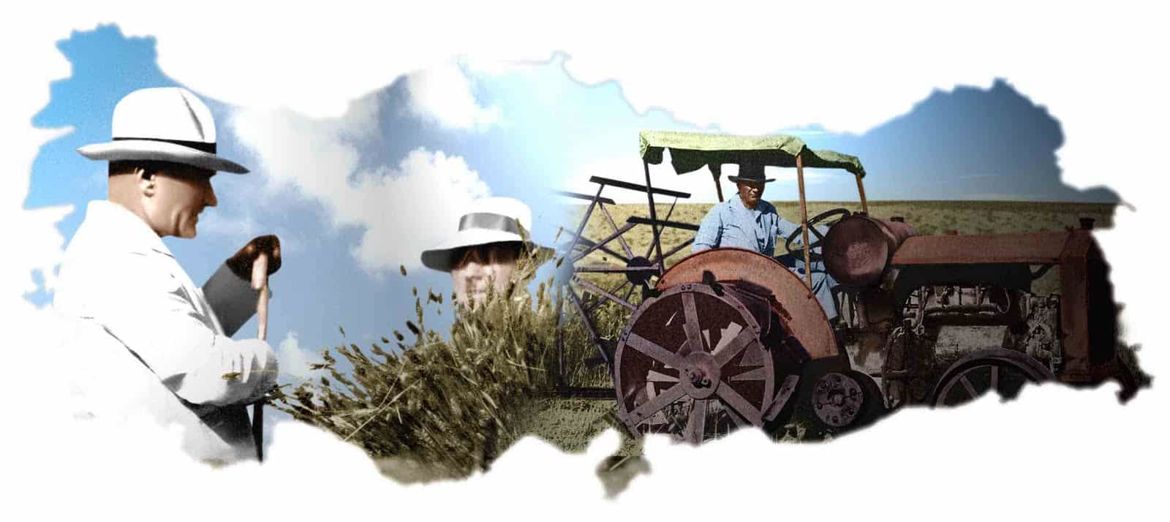
As I am also a farmer, I know that agriculture cannot be practiced without machinery. Manual labour is difficult. Unite! Through associations, you can purchase machinery. You may work one hundred decares a year, cultivate ten times as much, and obtain a hundred times the yield. One must also find and sow the seed best suited to the soil. Our country has not yet earned the right to call itself an agricultural country. We shall become an agricultural country. And this can only be achieved through mechanized agriculture.
Manual labour is not sufficient. Machinery must be utilized. We shall set aside the ploughs we have used for centuries. We shall bring into the country all the agricultural tools and equipment required by the progress of the age. We are obliged to supplement human strength with machinery. But merely working and merely obtaining agricultural tools and equipment are not sufficient. One must also know how to work; for this, science is necessary, technology is necessary, and culture is necessary. Therefore, our farmers must be educated from this perspective. This is the path we shall follow.
Remember also the vastness of our country and how disproportionate our population is to this vast territory. In order to cultivate and utilize these extensive and fertile lands, we are absolutely obliged to compensate for the shortage of manual labour through technical equipment. Our country is an agricultural country; therefore, the majority of our people are farmers and shepherds. Consequently, it is in this field that we can demonstrate our greatest strength and power and enter major arenas of competition.
Our country is very large, our land is abundant, and our time is limited. We must act quickly in order to cultivate this vast and fertile country and transform its resources into wealth that will ensure the happiness of the nation. Therefore, we shall make use of machinery. The treasures of wealth in this country can no longer be developed with the old ploughs we have been using for centuries. All our farmers must own machinery, know how to use machinery, and possess institutions capable of producing machinery.
And even this is not enough, gentlemen! If we allow the products of this labour to rot in the fields, villages, and threshing floors, the people's efforts will go unrewarded. These products must also be capable of being transported elsewhere. For that, roads are necessary, various means of transport are necessary—railways, automobiles, and others… How regrettable it is, gentlemen! Although Konya, Eskişehir, and many other places are treasures in themselves, their products cannot be transported elsewhere because of the lack of transportation facilities. We import some of the wheat we need from abroad; can such a thing be acceptable?
The foundation of the national economy is agriculture. For this reason, we attach great importance to agricultural development. Planned and practical efforts extending all the way to the villages will facilitate the achievement of this objective. However, in order to bring this vital undertaking successfully to its objective, it is first necessary to determine an agricultural policy based on serious studies and, accordingly, establish an agricultural system that every villager and every citizen can easily understand and willingly implement. The principal points that may occupy an important place in this policy and system can be summarized as follows: First of all, no farmer in the country should be left without land. More importantly, land sufficient to support a farming family should, under no circumstances, be divided. The amount of land that large farmers and farm owners may operate should be limited according to the population density and soil productivity of the regions in which the land is located.
Measures to increase, modernize, and protect the working tools of all farmers, large and small, must be taken without delay. The country should be divided into agricultural regions according to climate, water resources, and soil productivity. In each of these regions, productive, modern, and practical agricultural centers should be established that villagers can see with their own eyes and take as examples for their own work.
Today, some of the farms under state administration and the various agricultural-industrial institutions within them have completed all kinds of technical and modern experiments across every field of agricultural life and activity and are ready to disseminate the most beneficial agricultural methods and practices in the regions where they are located. This will provide significant advantages for the Ministry. However, in order to ensure that both the existing agricultural centers and those to be newly established throughout all agricultural regions of the country can continue their fully productive activities without interruption and can manage and develop themselves through their own revenues without imposing a burden on the state budget, all these institutions should be combined into a broad operating organization. Furthermore, beginning with wheat, every necessary technical and legal measure must be taken without delay to increase the quantity, improve the quality, reduce production costs, and combat diseases and pests affecting all our food requirements, the various raw materials upon which our industry depends, and the different products that form the basis of our foreign trade.
Providing land to farmers is also a matter that the government must pursue without interruption. Providing working Turkish peasants with as much land as they can cultivate is one of the principal means of increasing the country's production.
It is absolutely essential that every Turkish farming family possess sufficient land on which to live and work. The sound foundation and development of the homeland depend upon this principle. In addition, we wish to encourage the cultivation of large landholdings with modern equipment in order to provide greater production for the country.
Efforts to improve the cultivation methods of tobacco, one of our most valuable and finest products, to educate and protect farmers in processing their crops and selling them at fair prices, and to increase exports to the highest possible level by making our tobacco better known in world markets are producing good results.
I would also like to emphasize the necessity of protecting our forest wealth. However, what is important in this regard is the need to reconcile the principles of conservation with the balanced and technical utilization of our forests, which must continuously meet the country's various needs for timber.
Maintaining our forests—which are unquestionably important both for agriculture and for the country's wealth and general health—in good condition through modern measures, expanding them, and obtaining the greatest possible benefit from them are among our fundamental principles.
Conditions for achieving agricultural development easily and rapidly have greatly advanced and matured. We see that assistance provided through sound organization, using new methods and modern machinery, will produce immediate results. Cooperative organizations have gained acceptance everywhere. We consider it possible to benefit from cooperatives not only for credit and sales, but also for teaching and facilitating the use of means of production.
In agriculture, importance must be attached to efforts aimed at preventing diseases.
I expect the Land Law to be brought to a conclusion through the distinguished work of the Grand National Assembly. It is absolutely essential that every Turkish farming family possess sufficient land on which to live and work. The sound foundation and development of the homeland depend upon this. In addition, we wish to encourage the cultivation of large landholdings with modern equipment in order to provide greater production for the country.
Maritime trade and the trade and industry of marine products constitute an important issue for us.
The organization necessary for the implementation of the Labour Law must be put into operation. In addition, new laws should be prepared for maritime and agricultural workers.
This year, the new draft law concerning Ziraat Bank will be among the matters on our agenda.
Whenever necessary to reduce the cost of living, we shall continue our policy of reducing taxes. The bold reductions we have made over the past two years in taxes on salt, sugar, cement, and livestock have proved beneficial in every respect.
These statements, which I have quoted verbatim from four separate speeches by Atatürk, together with statements he made at different places and times, and their meanings, offer solutions to the chronic problems we experience in agriculture today and are likely to continue experiencing in the future.
In fact, as an Agricultural Engineer, I find it deeply regrettable that these statements are not taught to students at universities.
I believe that adding a comprehensive course entitled “Atatürk and Agriculture” to the curricula of Faculties of Agriculture would contribute positively to the advancement of our country in the fields of agriculture and food.
Until his death, Atatürk eliminated outdated structures that exploited the public in Türkiye’s agriculture and food sector and introduced numerous innovations. In preparing Turkish agriculture for the future, he either personally introduced or paved the way for many landmark achievements that were inscribed in golden letters in the history of the Turkish Revolution and left as a legacy to future generations.
Among the most important priorities of the Republic of Türkiye under Atatürk’s leadership at that time were abolishing the heavy taxes imposed on villagers, providing villages with financial resources and credit, improving and protecting farmers’ products, increasing farmers’ knowledge and awareness, distributing land to landless farmers, and creating an educated professional community capable of explaining agriculture to rural communities in the best possible way, following developments, and determining agricultural policies.
At this point, it is useful to briefly recall some important developments.
With Law No. 552 dated February 17, 1925, the “tithe tax” (Aşar) was abolished. Since abolishing the tax would lead to a decline in state revenues, it was envisaged that a tax varying between 8% and 10% would be levied on products offered to the market, based on local or market prices.
Efforts were made to rapidly train cadres for the agricultural sector who embraced scientific thinking, were open to development, capable of independent thought, could contribute to the enlightenment of villages, and could carry out land reform. With the “Law on the Improvement of Agricultural Education,” enacted on June 17, 1927, the Higher School of Agriculture and the Higher Veterinary Institute were opened in Ankara. Numerous students were sent abroad to receive advanced technical education. The Sericulture Institute was established in Bursa; Sericulture Schools were opened in Antalya, Diyarbakır, Edirne, and Erzincan; and multi-purpose agricultural schools were established in İzmir, Erzincan, Kastamonu, Konya, Çorum, Sivas, Erzurum, Edirne, and Kepsut.
Despite all financial difficulties, livestock farming was placed under protection. Farms engaged in animal husbandry were supported, and breeding animals were distributed. Livestock markets were opened in Ankara, Istanbul, İzmir, Bursa, Konya, Eskişehir, Kırklareli, Kayseri, Adana, Diyarbakır, Sivas, Erzurum, and Kars.
In 1928, the “Animal Health Police Law” was enacted. The implementation of this law, which introduced a new dimension to Turkish veterinary medicine and contained approaches that were not available even in some developed countries at the time, was extended throughout the country through the comprehensive 517-article “Animal Health Police Regulation” issued in 1931.
In order to provide farmers with production capital, long-term interest-free loans were made available, and the lending conditions of Ziraat Bank were eased.
In 1924, the Agricultural Credit Associations Law was enacted. To complement this legislation, Law No. 1470 on Agricultural Credit Cooperatives was adopted in 1929. The law aimed to enable “hard-working and enterprising” farmers who had no property to offer as collateral to obtain loans based on their “personal creditworthiness,” without expenses or guarantors. Considerable success was achieved by bringing credit directly to farmers, an initiative described as a “genuine and profound revolutionary movement” in the rural economy.
Saplings were distributed to the public free of charge.
In 1937, the Agricultural Combines Administration was established to purchase agricultural tools, machinery, and chemicals and introduce them to the public.
The Agricultural Equipment Institution met farmers’ needs for agricultural tools, machinery, and chemical fertilizers.
Under Atatürk’s directive and in line with the requirements of modern agriculture, secondary agricultural schools were opened in Istanbul, Bursa, İzmir, and Adana in 1930, alongside the Ankara Higher School of Agriculture.
Under a law adopted in 1925, state-owned land began to be distributed to villagers; where suitable state-owned land was unavailable, the state purchased land for distribution. During the first ten years, more than one million decares of land were distributed to villagers.
Farmers who acquired land were allowed to repay their debts for land, seed, and agricultural equipment over a period of 20 years.
A rule was adopted exempting newly cultivated land, newly established nurseries, vineyards, and olive groves from taxation for a specified period.
Science was prioritized, importance was attached to R&D and education, and cooperatives were supported.
Agricultural policies were formulated in a manner that would protect the soil and natural resources.
Model state farms were established to implement modern agricultural practices while remaining financially self-sufficient without burdening the state budget.
Beginning in 1925, Atatürk implemented practices on his own farms that radically transformed the traditional understanding of agriculture and served as examples for farmers. Atatürk owned the Gazi Forest Farm in Ankara, Tekir Farm in Silifke, Baltacı Farm in Yalova, Piloğlu Farm in Tarsus, Karabasamak Farm in Dörtyol, as well as a brewery in Ankara. Since 1925, these enterprises had been used to implement and disseminate innovations in agriculture. Atatürk donated them to the state in June 1937.
On June 24, 1938, the Turkish Grain Board (Toprak Mahsulleri Ofisi – TMO) was established.
Whenever deemed necessary to protect wheat prices, the government also undertook wheat purchasing and sales operations through Ziraat Bank and the Turkish Grain Board.
The year is 2021…
The amount of food wasted by developed countries is sufficient to feed poorer countries.
The number of countries living at the threshold of subsistence and requiring food assistance has increased considerably.
The rapprochement and hostility between countries have increasingly become dependent on agricultural products.
Water and food resources, as well as their trade, have now become determining factors in defining the poverty or strength of nations.
The agricultural products-based food industry continues to grow every day.
Pandemic conditions have brought agriculture, food, and water even further to the forefront.
The question, “Could there come a time when we no longer have a ‘Mother Earth’ on which to live?” is on everyone’s mind.
Local products and local production emerged stronger from the conditions created by the pandemic, demonstrating the importance of localization to everyone.
Environmental pollution and climate change stand before us as some of the most significant threats of our time.
Conclusion…
THE WORLD’S MOST POWERFUL WEAPONS OF WAR
AGRICULTURAL AND FOOD PRODUCTS, AND WATER
With his foresight, enlightened thinking, scientific approach, and ability to read, think, interpret, and foresee from those days the challenges we face today—and to take measures accordingly—the pioneer of Modern Turkish Agriculture was:
Great Leader Mustafa Kemal ATATÜRK
REFERENCES:
GÜRBÜZ, M., 1989. Tarım, Orman ve Köyişleri Bakanlığı’nın Tarihi Gelişimi, TODAİ Uzmanlık Tezi, Ankara.
DEMİRCİ, R., ÖZÇELİK, A., 1990. Tarım Tarihi, Ankara Üniversitesi Ziraat Fakültesi Yayınları, Yayın No:1186, Ankara.
ÖZ, M., 2000b. Osmanlıda Klasik Dönemde Tarım, Yeni Türkiye Yayınları, Cilt:3, Ankara.
YAVUZ, F., 2005 Türkiye’de Tarım, Tarım ve Köyişleri Bakanlığı Yayınları.
ÖZÇELİK, A., Tarım Tarihi ve Deontolojisi, Ankara Üniversitesi Ziraat Fakültesi Tarım Ekonomisi Bölümü Ders Notları.
BARKAN, Ö.L., 1980 Türkiye’de Toprak Meselesi, Gözlem Yayınevi
AVCIOĞLU, D., 1996 1835 den 1995 e Milli Kurtuluş Tarihi, Tekin Yayınevi.
ÖGEL, B., 2014 Türk Mitolojisi, Türk Tarih Kurumu Yayınları.
ÖZGÜN, C., 2014 1844-1914 Bereketli Topraklarda Üretmek ve Paylaşmak, İzmir Büyükşehir Belediyesi Yayınları.
SERÇE, E., YETKİN, S., 2011 120. Yılında İzmir Ticaret Borsası Tarihi, İzmir Ticaret Borsası Yayınları, Yayın No: 90, İzmir.
KEYKUBAT, B., 2017 Türkiye Yönünü Bir An Önce Seçmeli, İzmir Ticaret Borsası Dergisi Sayı:98, Sayfa:38
KEYKUBAT, B., Apelasyon E Dergi https://apelasyon.com/yazi/54/
ÇAMUROĞLU, G., 2009 Türkiye Cumhuriyeti Toprak Reformu ve Milli Burjuvazi Yaratma Çabası, Gazi Üniversitesi Hukuk Fakültesi Dergisi, Cilt: XIII, Sayı:1-2
ERKUN. V., 1988 Atatürk Döneminde Tarım Politikası, Atatürk Araştırma Merkezi Dergisi, Cilt XIV, S:42
İNCİ. İ., 2010 Atatürk’ün Yönerge ve Öğütleri Işığında Türk Tarımındaki Gelişmeler 1923-1938, Atatürk Araştırma Merkezi Dergisi, Sayı 77, Cilt: XXVI
ÖZTÜRK. S., YILDIRMAZ, F., 2009 Osmanlı İmparatorluğunun İktisadi Çöküşü ve Atatürk Dönemi İktisat Politikaları, C.Ü. İktisadi ve İdari Bilimler Dergisi, Cilt:10, Sayı:2
DOĞAN, H., Atatürk’ün İşlevsel Eğitim Anlayışı
AYBARS, E., 2006 Atatürk ve Modernleşme, Zeus Kitapevi.
16 Mart 1923’de Türk Ocağı binasında Adana Çiftçileriyle konuşma, ASD II, s. 127.
ATATÜRK Büyük Nutuk (Söylev), 15-20 Ekim 1927
AYBARS, E., 2014 Bir Uygarlık Örneği: Türk Devrimi, Zeus Kitapevi.
AYBARS, E., 2000 Türkiye Cumhuriyeti Tarihi, Ercan Kitapevi.
AYBARS, E., 1987 Milli Mücadelede İngiliz Basını I,II 1920-1923 Sevr’den Lozan’a.
TEZEL, Y.S., 1994 Cumhuriyet Dönemi’nin İktisadi Tarihi 3.Baskı, Tarih Vakfı Yurt Yayınları
KAYA, Y., 2001 Bozkırdan Doğan Uygarlık Köy Enstitüleri l.Cilt, Tiglat Matbaacılık
DONAT, İ., Atatürk’ün Tarım Politikası, Tarım Analiz-BloombergHT.
KARAGÖZLÜ, C., 29.10.2004 Atatürk ve Türk Tarımı, Akşam Gazetesi
YILDIRIM, A.E., Mustafa Kemal Atatürk ve Tarım İle İlgili Düşünceleri
KAYMAKÇI, M., 2015, Siyasi Partilerin Tarım Politikaları Nasıl Olmalı Süt Dünyası Dergisi
BORATAY, K., 2004, Tarımsal Yapılar ve Kapitalizm İmge Kitap Evi Yayınları 3. Baskı.
Beş Yıllık Kalkınma Planı Tarımsal Politikalar ve Yapısal Düzenlemeler Özel İhtisas Komisyonu Raporu. Ankara: DPT.
ÇAKMAKÇI, L., Dünyada ve Türkiye’de Kırsal Kalkınma, http://ankaenstitusu.com
http://www.ciftcikulubu.net/ataturk-ve-tarim/
http://agrikem.com/once-tarim-ataturk-ciftlikleri/
http://www.tarimkredi.org.tr
Blog Photos
Writer : Bilge Keykubat
Unless otherwise stated, this published article does not reflect the views of the Izmir Commodity Exchange. 


