
Traditional Global Trade Routes and Hubs Are Changing Rapidly.
Türkiye Must Choose Its Direction as Soon as Possible
The world is currently going through a period that could fundamentally transform the balance of international trade in many different ways. New trends, new relationships and new needs are rapidly emerging in line with the demands of the modern era. Keeping up with developments has become increasingly difficult. Daily events are unfolding at a dizzying pace.
Recent developments in Western countries include:
- Italian Prime Minister Matteo Renzi announcing his resignation following a crushing defeat in the constitutional referendum (an indication that Italians, like the British, have rejected pro-EU policies),
- The Brexit decision, marking the United Kingdom's withdrawal from the European Union,
- Austrian voters choosing a left-leaning president in the latest election,
- The election of a socialist leader known for his close ties to Russia as president in Bulgaria's latest election,
- Rumors that Russian banks provided 27 million euros to Marine Le Pen, leader of France's far-right National Front, along with the upcoming French presidential election and the possibility of Le Pen being elected,
- The influence and political philosophy of the newly elected US President Donald Trump,
- Former European Parliament President Martin Schulz becoming the German Social Democratic Party's candidate for Chancellor. His candidacy against Chancellor Angela Merkel in the upcoming election indicates that September and October will see an intense election campaign filled with new promises and political rhetoric,
- The growing influence of the Iranian public in the upcoming presidential election, as public support for the current government appears to be nearing exhaustion,
- The results of the recent Dutch elections, which defied opinion polls,
- And, of course, the monetary policy decisions of the US Federal Reserve (FED), particularly its interest rate moves.
 International experts regard these developments as signs that the EU may face difficult times, both in terms of its unity and its economic stability.
The rapprochement between Iran and Russia observed in light of recent developments adds a new dimension to the situation. Russian aircraft taking off from Iranian airbases to bomb targets within Syria is one indication of this cooperation. Furthermore, the longstanding policies of the United States and EU countries toward Iran have also driven Iran away from the West. As a result of these developments, the energy and food sectors have become increasingly important strategic concerns for both Russia and Iran.
In response to these developments, Russia, Iran and China are expected to seek a more influential role in the global energy market, while also working to strengthen their influence in the global food market by including Brazil in their cooperation.
Central Asia has attracted increasing attention in recent years. The possibility of confrontation between China and Russia as both seek to draw the region into their respective spheres of influence, combined with Türkiye's involvement through its cultural heritage and ethnic ties with the Turkic republics of Central Asia, makes significant changes in the direction of global energy and food markets almost inevitable.
The world is currently on the verge of major new developments. At any moment, a global superpower could begin to decline, while a mid-sized country could emerge as a major international player. Climate conditions, water resources, food supplies and land are becoming increasingly important. Water and food resources, together with their trade, are now in a position to determine the economic strength or vulnerability of nations.
According to the latest FAO reports, the number of countries requiring food assistance has increased significantly. Civil wars, refugee crises and climatic factors are placing considerable pressure on food availability and food security. Declining household and national incomes, rising agricultural commodity prices, inadequate food distribution networks and the continued deterioration of these conditions are further intensifying these pressures.
Import dependency for agricultural inputs, particularly in countries whose incomes rely heavily on agricultural products, also represents a major challenge for developing economies.
Russia, China, India, Brazil, Mexico, Pakistan and Indonesia are among the countries with the world's largest populations and lowest-cost labor forces. Unemployment and poverty in these countries have brought sections of their populations to the point of challenging their governments and political systems and demanding change.
Kazakhstan, Uzbekistan, Kyrgyzstan and Tajikistan have undergone significant political and economic transformations in recent history. With their vast territories and diverse characteristics, these countries are increasingly preparing to demonstrate their potential on the international stage.
Southeast Asian countries have also begun revitalizing their previous regional alliances and have even entered into new forms of cooperation.
Until relatively recently, the countries mentioned above were underestimated and dismissed by developed Western nations. 
The reasons behind the growing cooperation among these countries are:
- Although their motivations may appear to be rooted in oppression and poverty, the primary factor is access to food;
- Their growing recognition of the importance of water, agriculture, food and land;
- Their realization that these seemingly simple concepts have the potential to bring even the world's greatest powers to their knees.
Today, food products have the power to fundamentally reshape global trade.
Regional organizations and economic partnerships that we have frequently heard about in the media recently, and are likely to hear much more about in the future, include:
- The Eurasian Economic Union (Armenia, Belarus, Kyrgyzstan and the Russian Federation), whose free trade agreement with Vietnam entered into force on October 5, 2016,
- Asia-Pacific Economic Cooperation (APEC) (this organization differs somewhat from other regional groupings because it also includes the United States. The US participation reflects its desire to maintain a close position in relation to BRICS and Shanghai Cooperation Organization member countries),
- Association of Southeast Asian Nations (ASEAN) (the Philippines, Malaysia, Thailand, Indonesia, Singapore, Cambodia, Laos, Myanmar and Vietnam),
- BRICS (Brazil, Russia, India, China and South Africa),
- Shanghai Cooperation Organization (SCO) (with India and Pakistan expected to join China, Russia, Kazakhstan, Kyrgyzstan, Tajikistan and Uzbekistan in 2017, the organization is anticipated to become the world's largest organization in terms of economic and military power. It is also suggested that one of Russia's underlying motivations for this cooperation is to secure at least one of its strategic fronts),
- Finally, the MINT countries (Mexico, Indonesia, Nigeria and Türkiye), a grouping introduced by economist Jim O'Neill. (http://www.bbc.com/)
These countries have made, and continue to make, significant advances and agreements among themselves in the fields of energy, industry and agriculture.
With their large populations, China and Russia occupy particularly important positions in agricultural trade. They act with an awareness of their ability to influence the economic prosperity or hardship of other countries. The significant impact of recent developments between Russia and Türkiye, particularly on agricultural producers in our region, serves as a clear example of this influence.
On the other hand, Russia and China also possess the capacity to profoundly influence the global livestock industry through their extensive pasturelands.
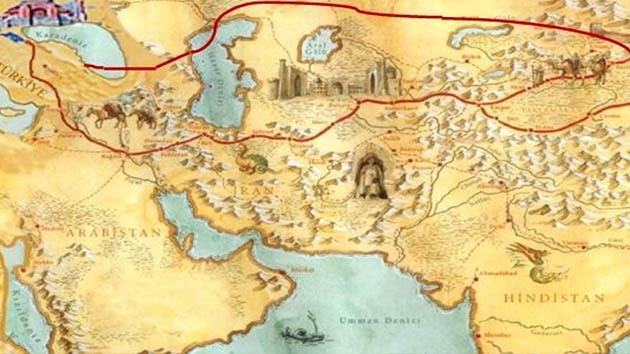
Major trade routes and commercial hubs that sustain national trade and economic activity have also begun to change and take on new forms as a result of recent developments.
Türkiye must closely monitor the developments outlined above and determine its strategic priorities accordingly, taking into account its agricultural sector, agro-based industries and the strength of its young population.
Remaining outside these recently established partnerships and their spheres of influence could result in missed opportunities for developing countries such as Türkiye.
Considering the influence and pressures exerted by EU countries on Türkiye's agricultural sector, the organizations and countries pursuing development and economic growth now represent alternative opportunities for our country.
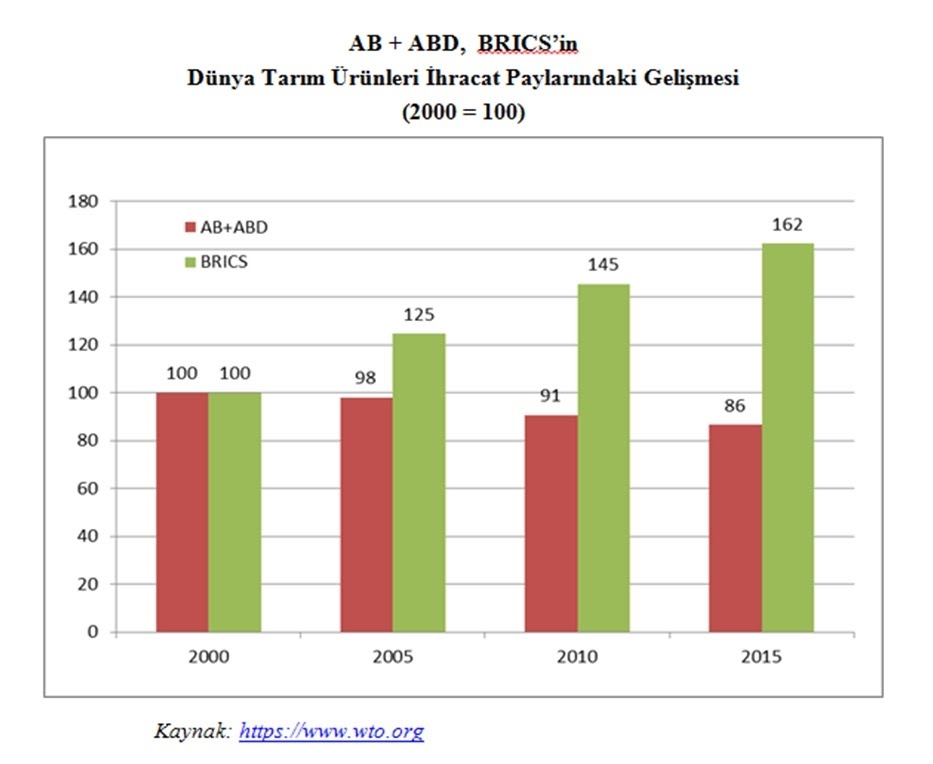
As clearly illustrated in the chart, while the shares of EU countries and the United States in global agricultural exports have declined since 2000, the export share of BRICS countries has increased (with the agricultural export shares of these countries indexed to 2000 = 100).
Alternative markets consisting of new countries and regional groups should not be overlooked, provided that developing trade relations with them does not adversely affect our agricultural trade with the EU. Initiatives undertaken in this context could also provide an opportunity to increase Türkiye's agricultural exports, which have not grown at a rate commensurate with the country's agricultural production potential.
It is impossible to remain unaffected by these changes in global trade flows. In today's world, where agricultural and food products are increasingly used as instruments of political and economic power, Türkiye must position itself at a strategic point along the emerging routes of global trade.
As traditional global trade routes and hubs continue to change rapidly, our ability to emerge from this transformation in the strongest and most profitable position depends entirely on us.
Blog Photos
Writer : Bilge Keykubat
Unless otherwise stated, this published article does not reflect the views of the Izmir Commodity Exchange. 


